Publication
Spaces in transition
Following footprints of migration workers from village to cities
- Project type
- Publication design
- Duration
- 16 weeks
- Tools and skills
- Adobe InDesign, Illustrator, Photoshop
- Client
- Academic project
- Status
- Launched
Overview
Introduction
A research book mapping the journey of construction workers in India from their hometown to construction site and narrating their lives from an architectural perspective
Context
Background
Construction workers are the unsung heroes of any architectural project. They appear on the site as the project begins, work throughout the duration and magically disappear as the project ends. Not only their contribution towards the project goes ignored, but sometimes their human values are also compromised. Often these construction workers are forced to live in squalor like condition in labour camps where families are crammed in as minimal space as possible with absolutely no regards to health and hygiene, let aside preserving cultural values. So to understand other aspects of lives of construction workers and shared responsibility we bear towards them as architects, a batch of students of architecture researched the topic and published their findings in the book — Spaces in transition.
Project history
This book is based on a study by students of architecture who followed such workers from the construction site to homes in their villages. The book also contains design suggestions to improve their living conditions in labour camps. The study was carried out in year 2015-16 as a part of academic requirement.
My role
I was part of 12 member team guided by 3 faculty members. The book contained data collected by a batch of 36 students and I was involved in collecting, sorting and organizing raw data, designing layouts for some sections in the book and final touch-ups including cover design. This was a semester (16 weeks) long project and my role shifted constantly throughout the duration.
Research
Hypothesis
We started with a hypothesis that migration workers who move to cities in search of work do tend to retain their cultural identity even after leaving their homes. Also the architectural elements of their background are reflected in spaces they occupy in the cities.
Their homes in village:
Their homes in cities:
Findings
But after studying some of the labour camps in Delhi, we realized that wasn't the case. Thus we grew interested in their backgrounds, their places of origin to understand their part of world which they sacrifice in search of work.
Process
Process
This was an year long (2 semesters equivalent of 32 weeks) research where we studied lives of construction workers on site in tier 1 & tier 2 cities in India and ultimately went to their villages to draw a comp
Challenges
The biggest challenge in the entire project was team collaboration. Distribution of tasks, compiling team members’ contribution in the project, creating a work structure so the book doesn’t come out to be 12 separate components and having everyone follow that was a major challenge in itself. Although everyone in the team pulled up their best, nonetheless differences in opinions came in the way a few times. Apart from that, collecting data and organizing it in a usable structure was another heavy task. The data was collected on random events and was kept with the respective student which made the collection a lot troublesome. Finally, a central repository was created which could be accessed by everyone in the team.
Approach
The book was divided into several chapters based on different aspects of the lives of construction workers like culture, built expression, occupation, etc. A comparison was made in each chapter comparing that aspect at their homes (in the village) with the labour camp on construction sites (in cities). The data was presented in the form of text, illustrations, tables & charts, architectural drawing and photographs. A final chapter consisted of efficient design solution for the construction camp to enhance the lives of workers on site.
Outcome
Final design
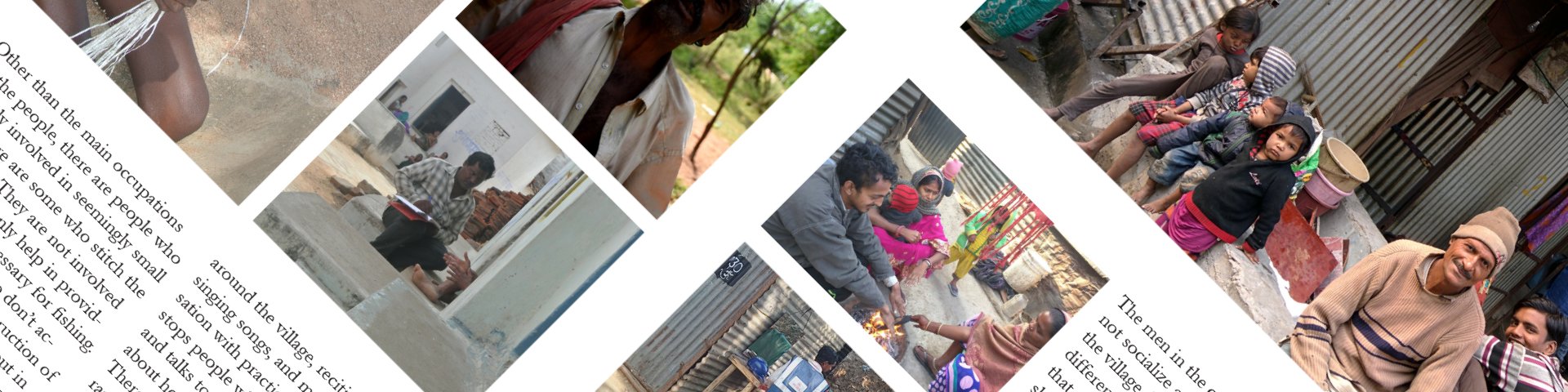
Here's a chapter from the book I worked upon which is based upon (alternate) occupation of workers and their families
Impact
The book was launched by the HOD of Dept. Of Architecture at School of Planning and Architecture, New Delhi. It was also presented in various design events including prestigious India Design fair at Pragati Maidan, New Delhi. Later, the Design Innovation Cell (DIC) took forward the research in that book as the base of their project concerning creating transient shelters for construction workers.
Learnings
From conception to final printing, book creation is a challenging yet interesting project. Apart from understanding the nuances of making a book, the project was also a great learning exercise in conducting and presenting research in a meaningful format. In the hindsight, we could’ve saved significant time and efforts in beginning by following a fixed layout structure and devoted that time in improving the presentation of information. The art of organizing information in structured fashion was important learning in my design education.